Nasa Picture Dataset

Buck Moon and Belt of Venus

Buck Moon and Belt of Venus

2026-08-01

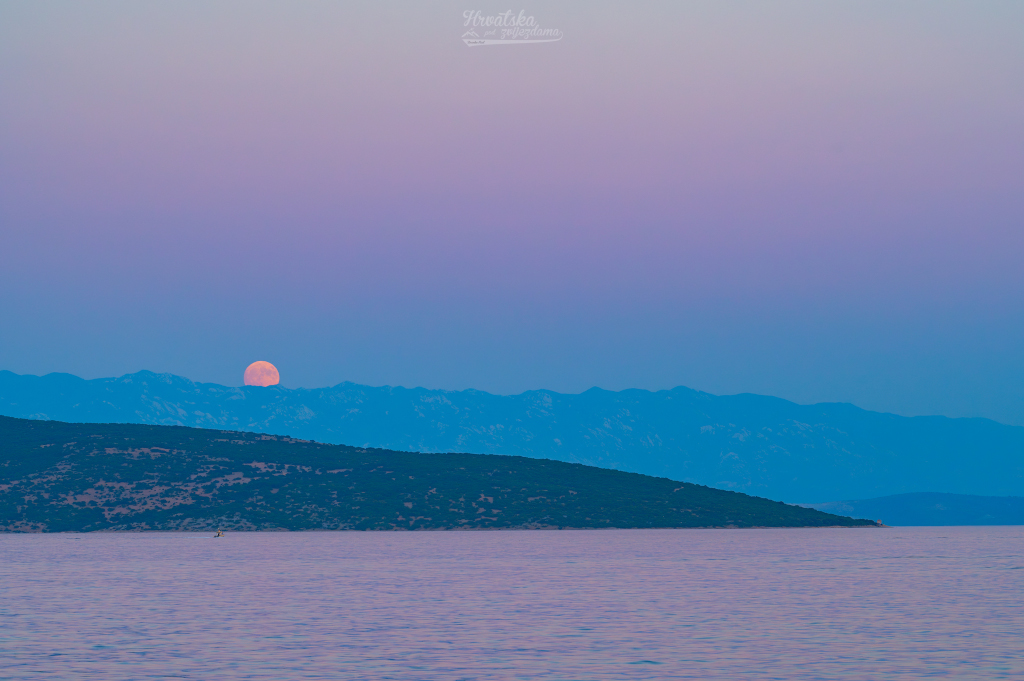
The Buck Moon is a traditional name for the full moon of July. In this colorful Adriatic sea and skyscape captured on July 28 from Krk Island along the coast of Croatia, a full Buck Moon is just rising over distant mountains. Since a full moon rises as the Sun sets, Earth's shadow also rises in the twilight scene, a diffuse gray band extending above the mountainous southeastern horizon. Above Earth's shadow band is the pinkish antitwilight arch. That subtly tinted band of backscattered sunlight is more widely known as the Belt of Venus. As it shares the eastern horizon with the atmospheric shadow of Earth and Belt of Venus, this full Buck Moon seems to set the stage for the New Moon to come. The New Moon of August 12 will cast its shadow on planet Earth in a much anticipated total solar eclipse.

A Fire Rainbow over West Virginia

A Fire Rainbow over West Virginia

2026-08-02

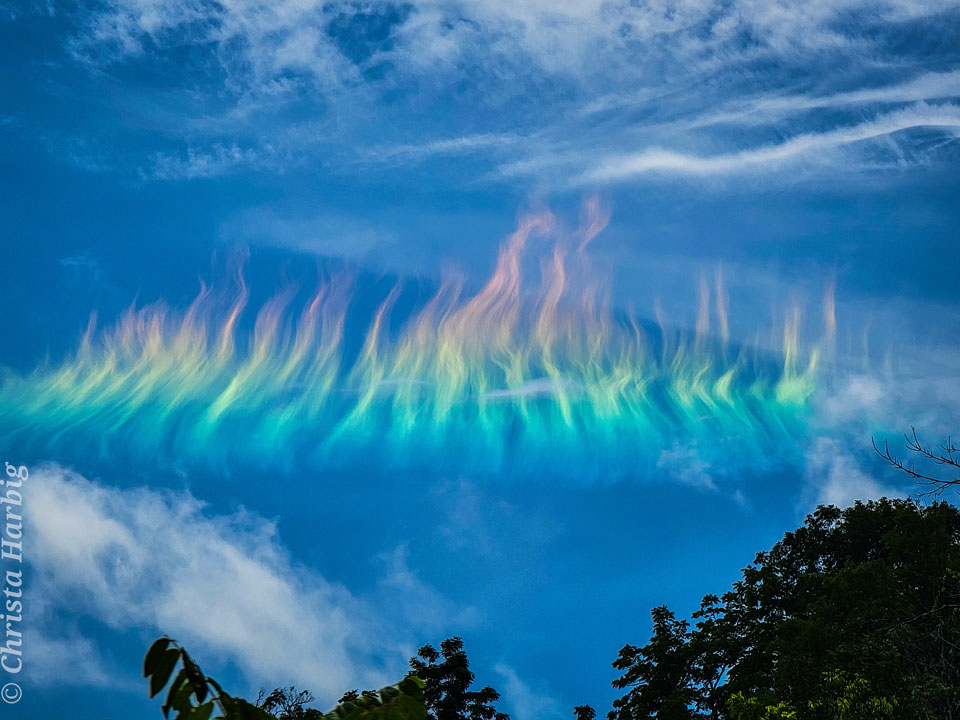
What's happening to this cloud? Ice crystals in a distant cirrus cloud are acting like little floating prisms. Known informally as a fire rainbow for its flame-like appearance, a circumhorizon arc appears parallel to the horizon. For a circumhorizontal arc to be visible, the Sun must be at least 58 degrees high in a sky where cirrus clouds present below -- in this case cirrus fibratus. The numerous, flat, hexagonal ice-crystals that compose the cirrus cloud must be aligned horizontally to properly refract sunlight in a collectively similar manner. Therefore, circumhorizontal arcs are somewhat unusual to see. The featured fire rainbow was photographed in 2021 near North Fork Mountain in West Virginia, USA. Sky Surprise: What picture did APOD feature on your birthday? (after 1995)

Vaporizing Meteor Photobombs the Lacerta Nebula

Vaporizing Meteor Photobombs the Lacerta Nebula

2026-08-03

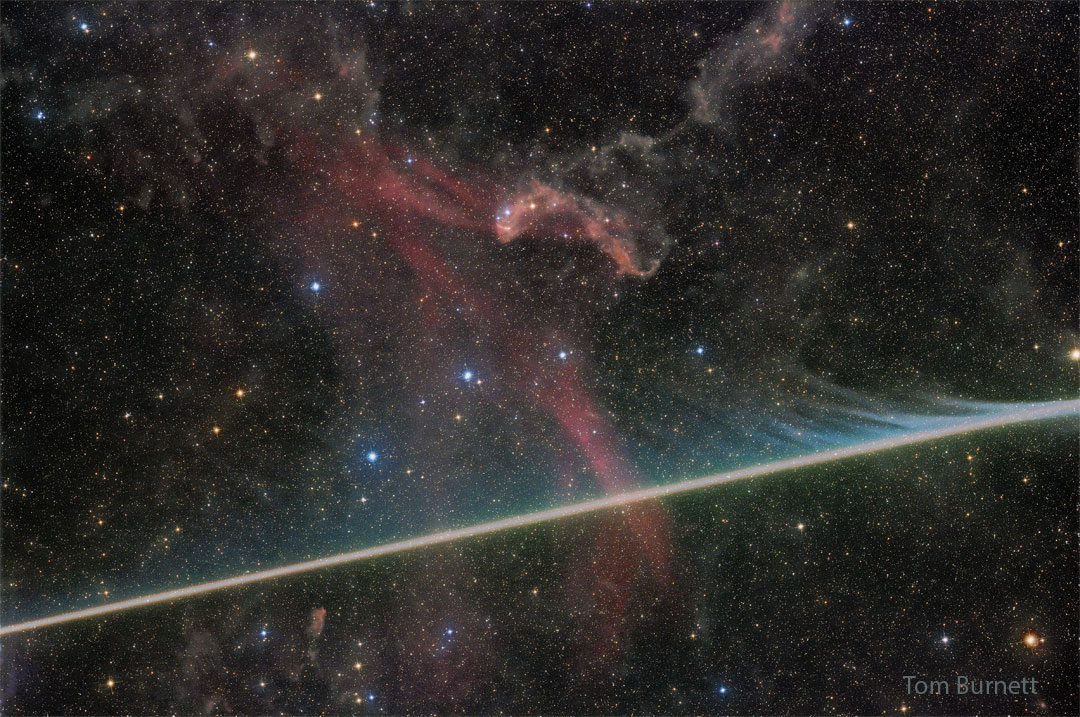
What's happening to this meteor? This bright meteor streak appeared and disappeared quickly during a long exposure of the Great Lacerta Nebula, seen faintly in red toward the center of the image. The meteoroid, likely a small pebble, creates its glow partly by heating and exciting surrounding air in Earth's atmosphere, but itself vaporizes and leaves wind-blown gas and dust with colors that give clues to its composition. The featured image was captured last month from Death Valley Observatories in Nevada, USA. This month, though, is particularly good for seeing meteors. Presently there are three meteor showers ongoing, although they are currently competing for visibility with the glow of a bright gibbous Moon. The most active of these showers, the Perseids, will be busiest in about 10 days -- after the Moon has dimmed considerably. This year, the Perseids peak nearly coincides with not only a new Moon, but, from some locations, one that totally eclipses the Sun. Sky Surprise: What picture did APOD feature on your birthday? (after 1995)

Curious Cometary Knots in the Helix Nebula

Curious Cometary Knots in the Helix Nebula

2026-08-04

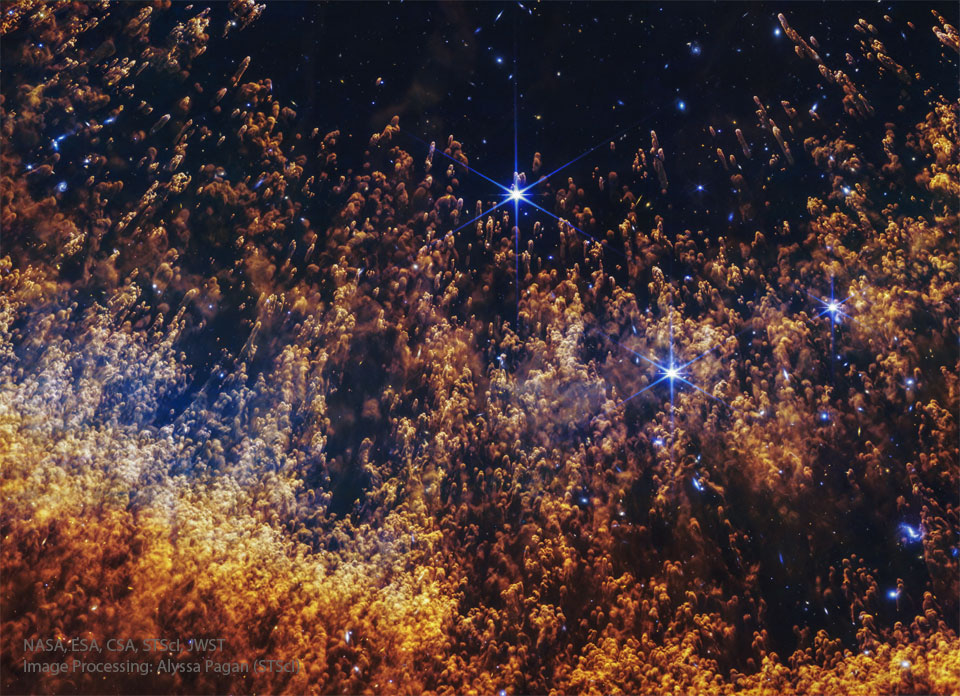
What causes unusual knots of gas and dust in planetary nebulas? Seen also in the Ring Nebula, the Dumbbell Nebula and NGC 2392, the knots' existence was not initially predicted, and their origins are still not well understood. Pictured here is a fascinating image of part of the Helix Nebula by the James Webb Space Telescope showing tremendous detail in infrared light. The cometary knots have masses similar to the Earth but have sizes typically several times the orbit of Pluto. One hypothesis for the fragmentation and evolution of the knots includes existing gas being driven out by a less dense but highly energetic stellar wind of the central evolving star. The Helix Nebula is one of the closest examples of a planetary nebula created at the end of the life of a Sun-like star. Given a technical designation of NGC 7293, the Helix Nebula lies about 650 light-years away towards the constellation of Water Carrier (Aquarius). Open Science: Browse 4,000+ codes in the Astrophysics Source Code Library

Spokes on Saturn's B Ring

Spokes on Saturn's B Ring

2026-08-05

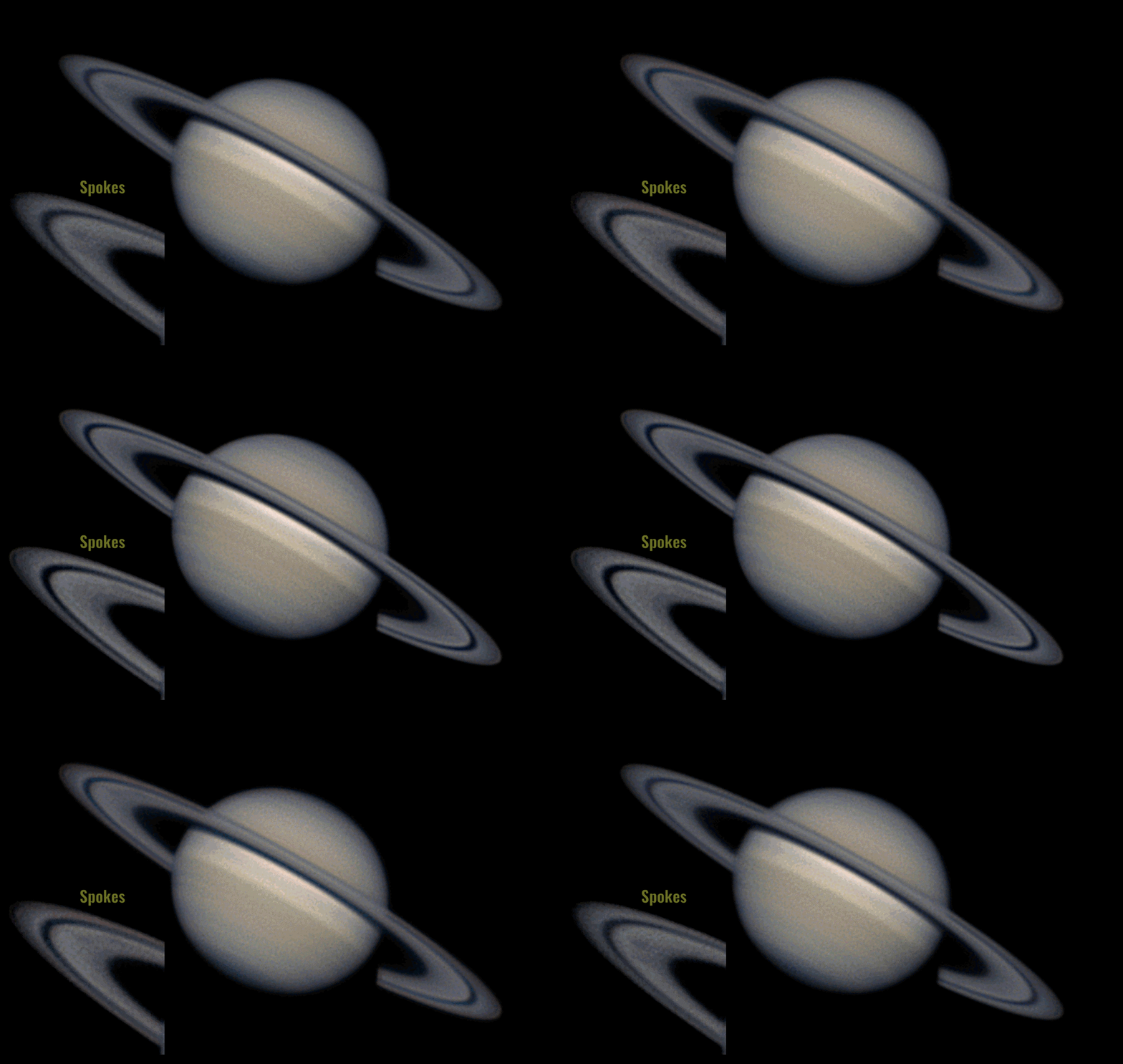
Don’t get spooked by Saturn’s ghostly spokes! Today we feature a nearly two-hour timelapse of Saturn and its rings looping forwards and backwards. If you look closely, a ghoulish shadow appears and disappears as Saturn’s B ring rotates. Decades of observation with Voyager 2, Cassini, and Hubble show the appearance of Saturn’s spokes varies with the planet’s seasons. Like Earth, Saturn’s spin axis is tilted compared to the plane of its orbit around the Sun. During Saturn’s equinox, the rings are less tilted toward the Sun and they receive sunlight at a shallower angle. Saturn’s spokes may be electrically charged dust and ice temporarily levitated above the rings by electromagnetic forces. It is still uncertain, but the ring plasma and charge environment may be influenced by changing ultraviolet illumination, meteoroid impacts, or indirect effects from interactions between the solar wind and the planet’s magnetic field. Note: The text of this APOD has been revised. Find dark skies and look up this August to witness the Perseid meteor shower uninhibited by the Moon!

New Sharpest Image of the Sun Uncovers Instability

New Sharpest Image of the Sun Uncovers Instability

2026-08-06

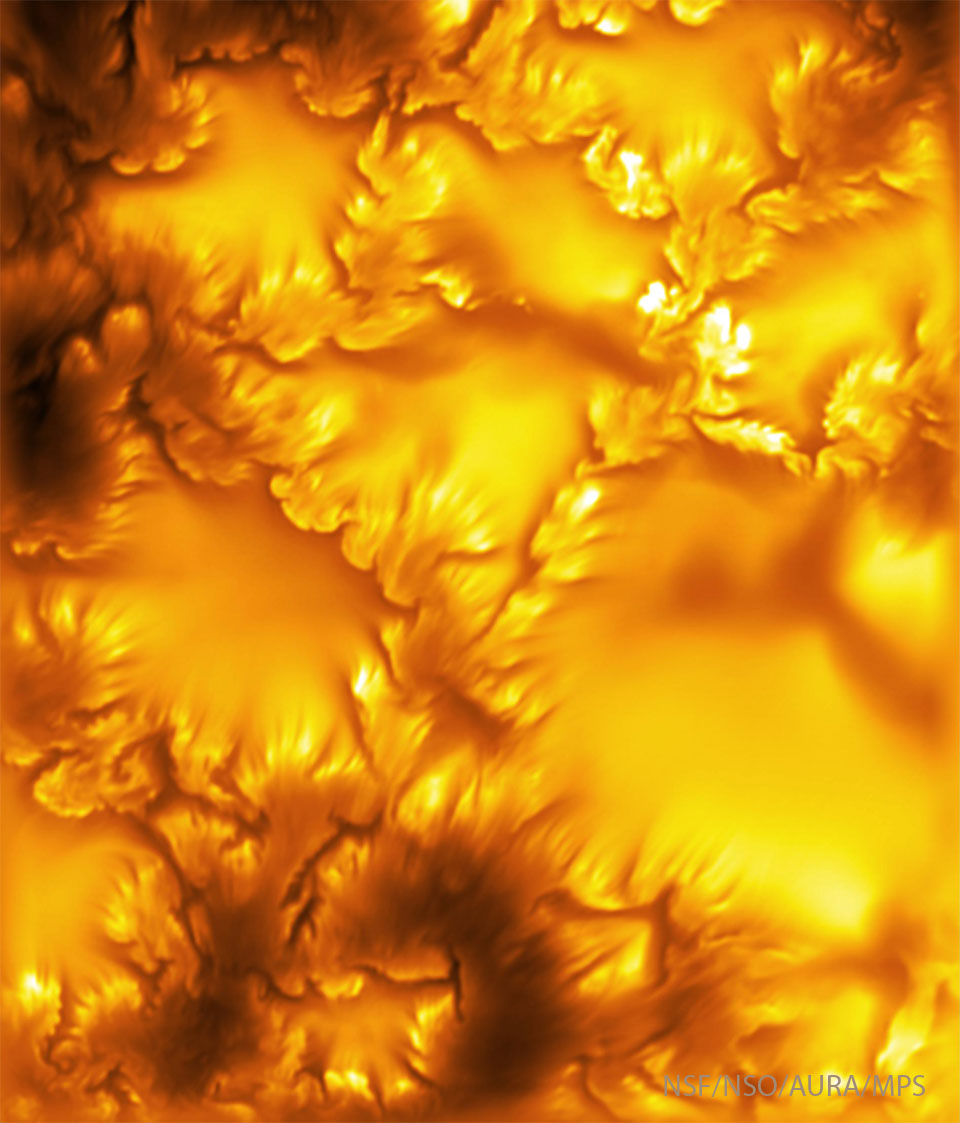
What does the new sharpest image of our Sun show? Instability. To be clear, a certain kind of interactive process called the Kelvin-Helmholtz instability (KHI). This instability can create waves and swirls when two streams flow past each other -- in this case variable streams of solar magnetic plasma. Long hypothesized to occur on the Sun's surface, KHI streaks and swirls were confirmed in just-released dramatic high-resolution images taken recently by the Inouye Solar Telescope in Hawaii, USA.  The featured false-yellow image, actually taken in deep blue, is the highest resolution image yet of the Sun in visible light. It spans about the radius of the Earth, but its finest details are city sized. Visible are several smooth tops of changing solar granules, while the edges of the flower-like structures have been found to harbor multiple KHI swirls. Future research may investigate how the KHI helps move energy and magnetic fields, and may even heat the surrounding solar corona.

Rubin's COSMOS field

Rubin's COSMOS field

2026-08-07

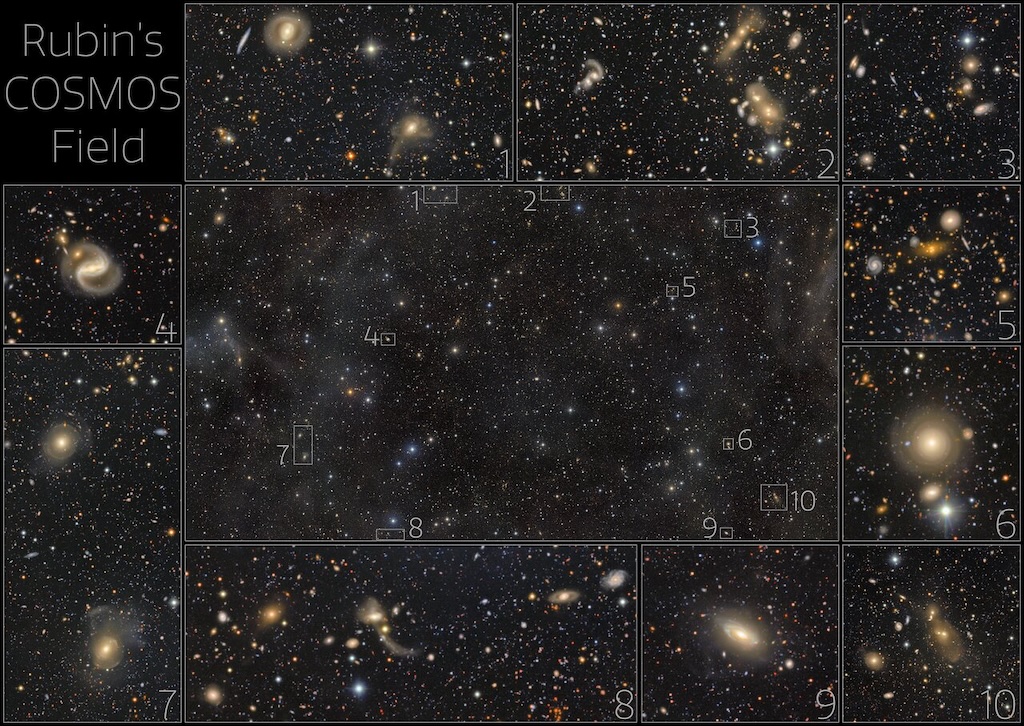
There are more than half a million galaxies in the central panel of this image from the NSF-DOE Vera C. Rubin Observatory in Chile. This is the COSMOS field, a patch of sky several times larger than the full moon, first observed by Hubble. It has also been observed by Webb and other telescopes because it contains comparatively few bright stars from our own galaxy, offering a relatively unimpeded view of other galaxies outside the Milky Way. The outer panels, numbered 1-10, show zoomed-in views of the corresponding small regions highlighted in the central panel. The variety of galaxy shapes and sizes is astonishing. Some of them are so far away that their light has traveled for billions of years before reaching Earth. Rubin will come back every couple of days to the COSMOS field as part of its ten-year Legacy Survey of Space and Time. It will allow a dynamic view of the COSMOS field and how the sky changes over time.

A Messier Moment for Tempel 2

A Messier Moment for Tempel 2

2026-08-08

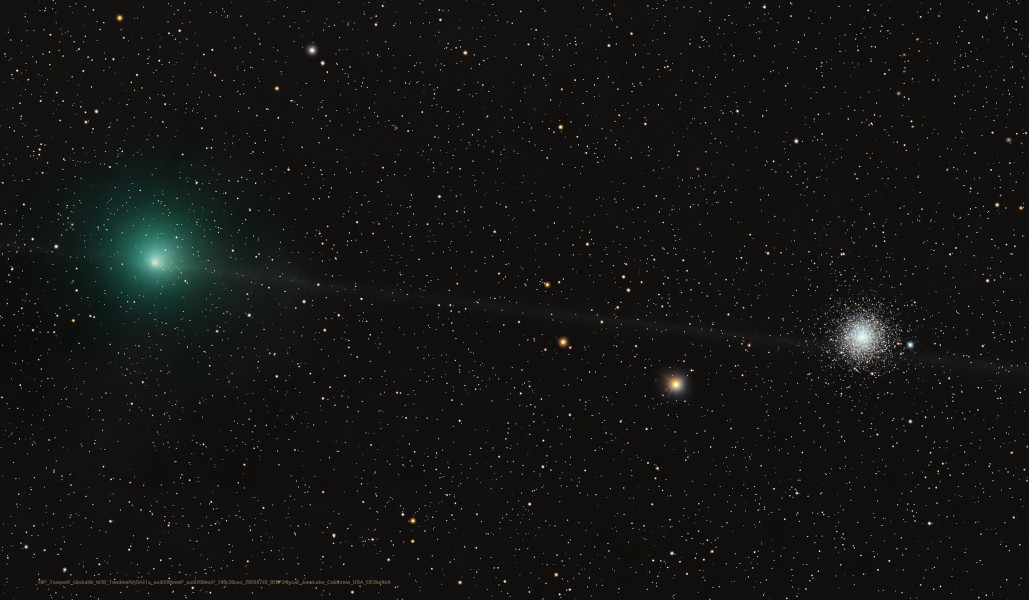
Which of these is not a comet? You guessed it - the one on the right is a globular star cluster. The diffuse greenish coma of periodic comet 10P/Tempel 2 is at left in the frame. In fact the globular star cluster is Messier 30, also known as M30, or the 30th entry in astronomer Charles Messier's catalog of things which are not comets. The well-known 18th century astronomer kept a list of objects he observed, now his famous Messier Catalogue of Nebulae and Star Clusters, which did not move from night to night against the background stars and so were not the comets he was hunting for. So the famous comet hunter would get the correct answer too, even though his telescope would show both 10P/Tempel 2 and distant star cluster as similar looking faint and fuzzy objects in his field of view. Recorded on July 29, this modern telescopic image captures periodic comet Tempel 2 as it briefly swept close on the sky to M30. While the periodic comet's faint, narrow, orbital dust trail seems to pierce the globular star cluster, Tempel 2 was a mere 3.5 light-minutes away. Messier 30 is some 28,000 light-years distant.

Contemplating the Sun

Contemplating the Sun

2026-08-09

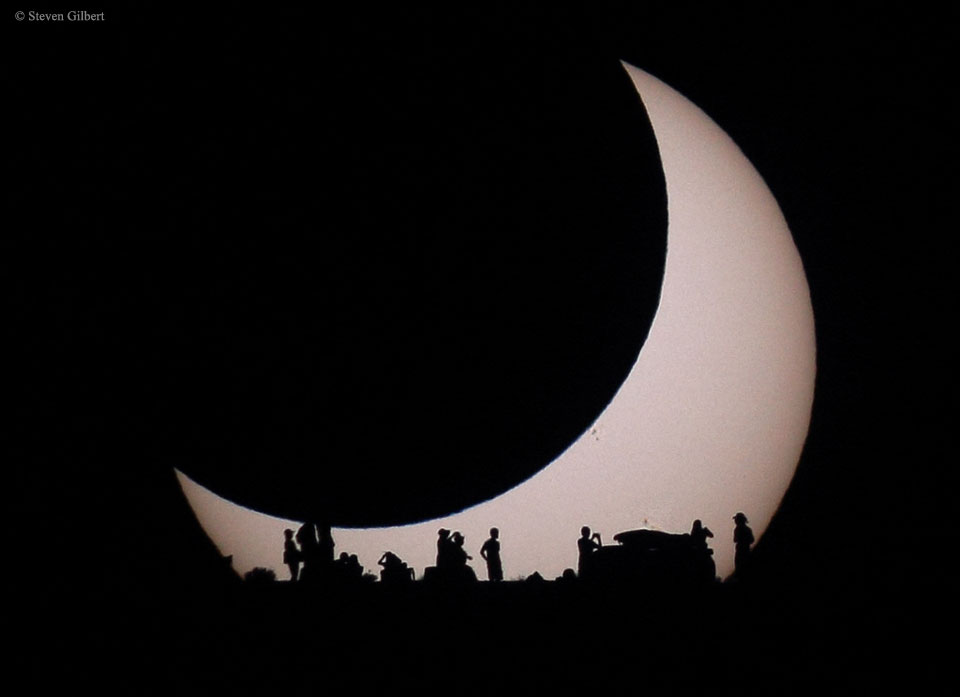
Have you contemplated your home star recently? Featured here, a Sun partially eclipsed on the top left by the Moon is also seen eclipsed by earthlings contemplating the eclipse below. This spectacular menagerie of silhouettes was taken in 2012 from the Glen Canyon National Recreation Area near Page, Arizona, USA, where park rangers and astronomers expounded on the unusual event to interested gatherers. Also, faintly visible on the Sun's disk, just to the lower right of the dark Moon's disk, is a group of sunspots. A new solar eclipse will occur this week and give many people in northern North America, Europe, and northwestern Africa a new chance to contemplate a partially eclipsed Sun. A thin swath of Earth through Greenland and Spain will further experience a total solar eclipse. An open question is whether any meteors from the peaking Perseids will be visible during totality.

Three Galaxy Pairs

Three Galaxy Pairs

2026-08-10

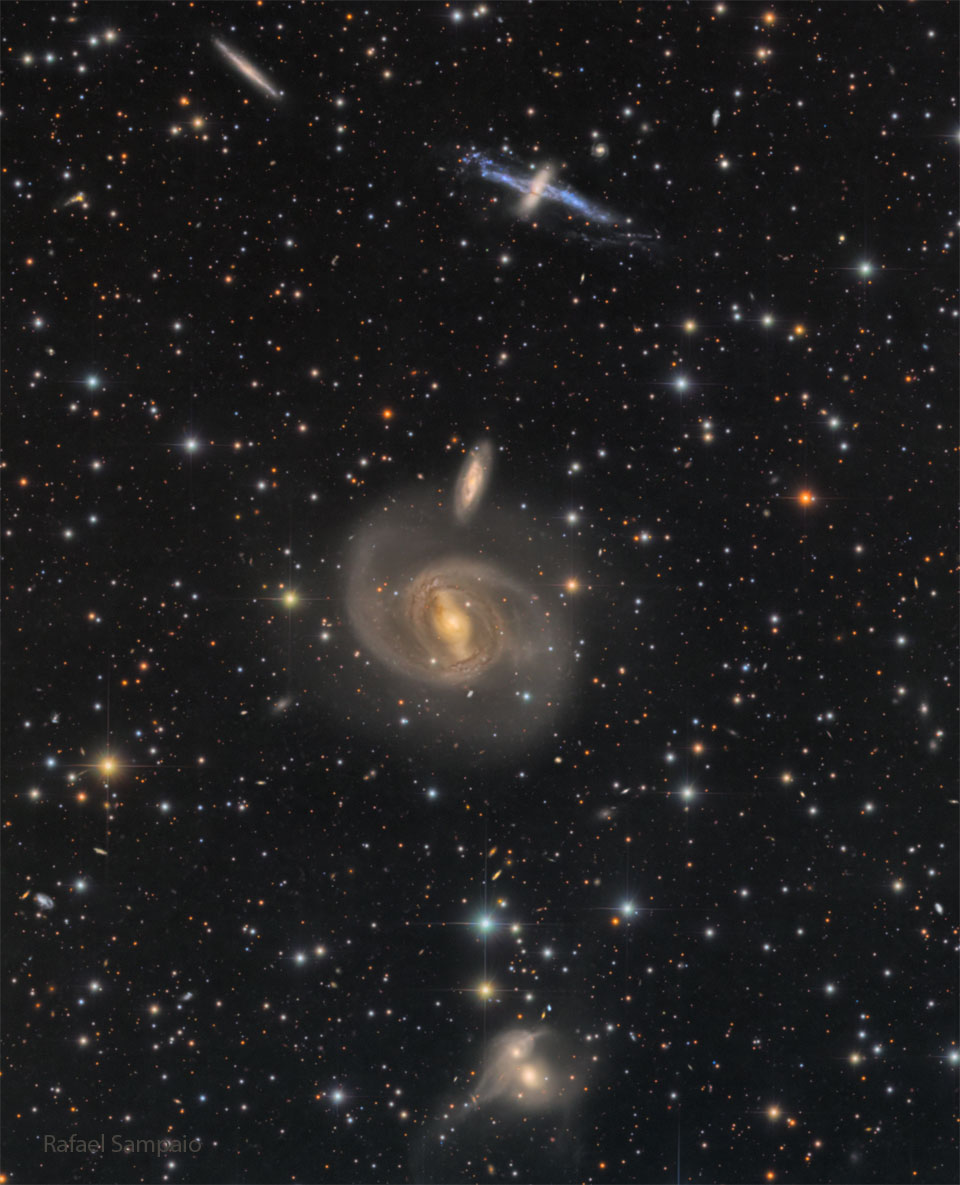
ch of these pairs of galaxies is different. The two galaxies at the top are likely not interacting, at least presently. However, the top galaxy with the blue stripe, NGC 4650A, is a polar ring galaxy and may be the result of a past galaxy collision. The two galaxies in the middle of the featured image appear like they could be interacting gravitationally -- but their relative speeds make this unlikely. Of these two, the larger galaxy, NGC 4650, is a spiral galaxy with a bright bar of stars across its center. The two galaxies at the bottom are actively interacting. Possibly in a billion years or so, NGC 4622A and NGC 4622B will merge and become one single galaxy. All of these galaxies are likely members of the larger Centaurus Galaxy Cluster. Explore the Universe: Random APOD Generator

Six Moons of Saturn

Six Moons of Saturn

2026-08-11

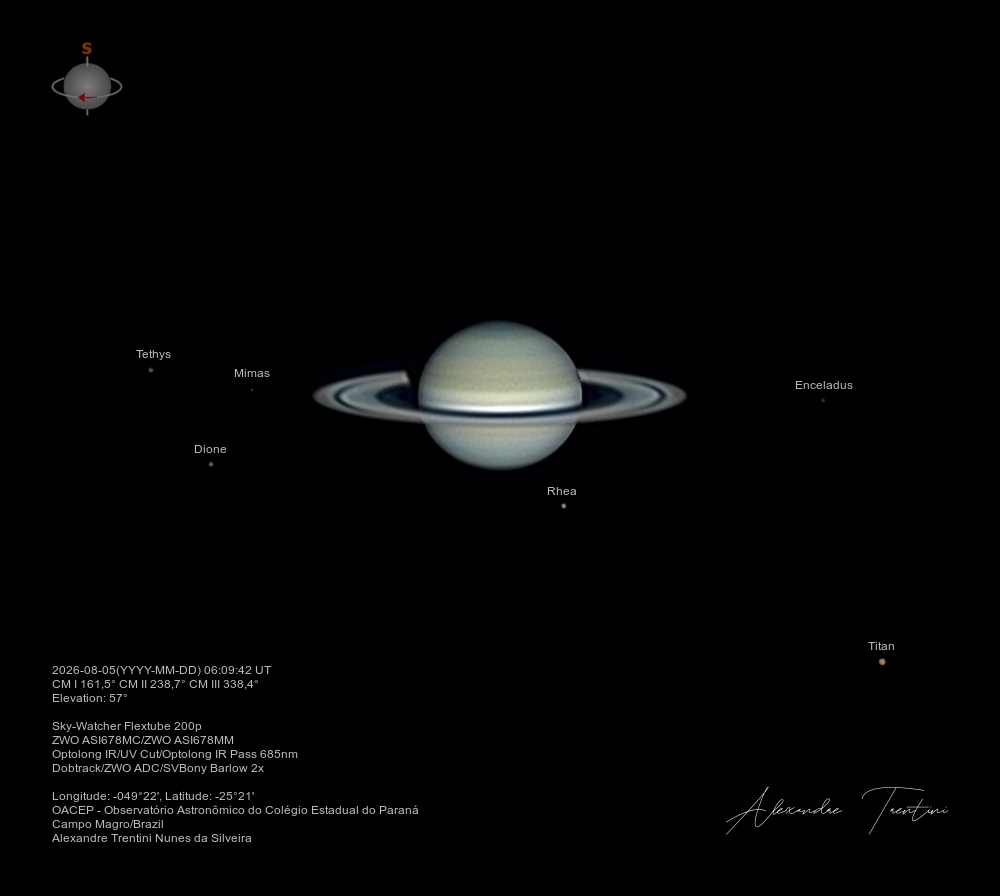
How many moons does Saturn have? While the total will likely continue to grow, as of June 2026 the ringed gas giant had 293 confirmed moons. That's easily more than any other planet of the Solar System, including ruling gas giant Jupiter with a mere 115 confirmed moons. Most of Saturn's known moons are small, irregular satellites. Many are only few kilometers to a fraction of a kilometer across and grouped in tilted outer orbits. Six of its largest satellites can be seen here, though, in this sharp telescopic Saturnian family portrait taken on August 5. Larger than Earth's Moon and even slightly larger than inner planet Mercury, Titan, with a diameter of 5,150 kilometers, is at lower right. You can also spot icy major moons Mimas, Tethys, Enceladus, Dione, and Rhea in the frame. Saturn's first known natural satellite, Titan was discovered in 1655 by Dutch astronomer Christiaan Huygens. During the space age Voyager and Cassini discoveries have added to the swelling ranks of Saturnian moons. NASA Stream: August 12 Total Solar Eclipse.

Perseids Over a little Planet

Perseids Over a little Planet

2026-08-12

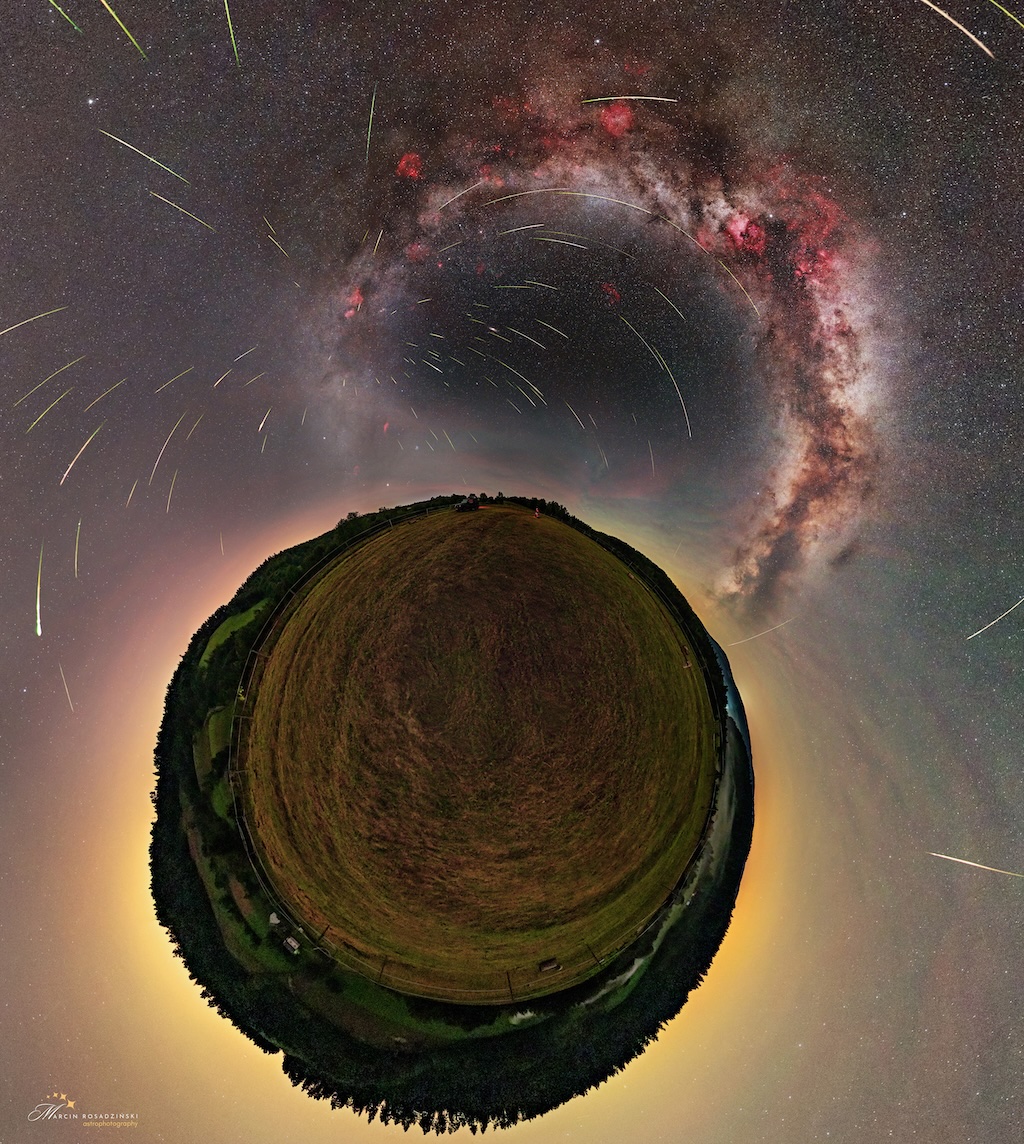
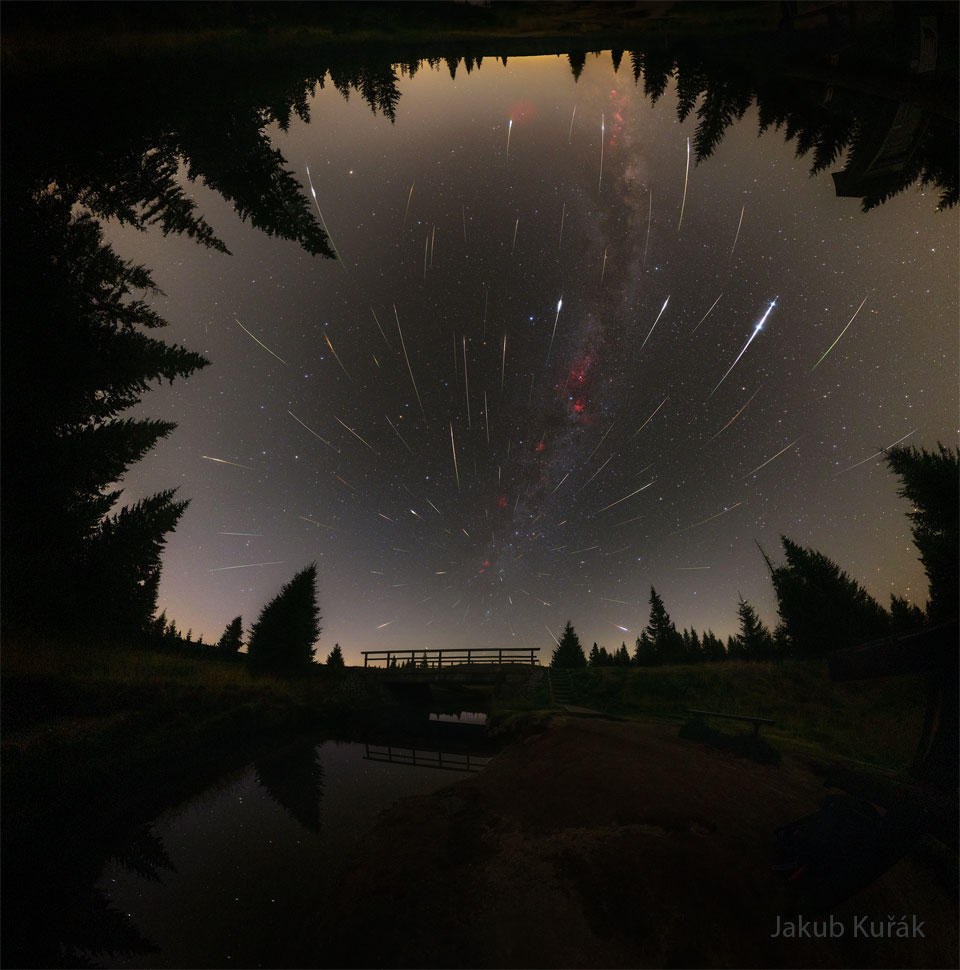
It looks like a view from the Little Prince's planet. The featured image is a throwback to the 2024 Perseid meteor shower, surrounded in this projection by the Bieszczady Mountains in Poland. Visible in the sky is the arch of the Milky Way, along with several nebulas in red and over a hundred meteors pointing to the radiant. The Perseids are easily visible and quite popular in the Northern Hemisphere summer. (Watching meteor showers in the winter is less convenient for a good reason). This year they are expected to offer an even more dazzling spectacle than usual, because the peak coincides with a new moon. The 2026 Perseid meteor shower will peak tonight with as many as 50-100 meteors per hour, when the Earth's path crosses through debris left behind by Comet Swift-Tuttle. Typically, the best times for seeing the meteors are between midnight and pre-dawn. You won't need binoculars to see the meteors, but a lawn chair and a dark sky location help. Growing gallery: Solar Eclipse of 2026 August 12

Total Solar Eclipse Over Spain

Total Solar Eclipse Over Spain

2026-08-13

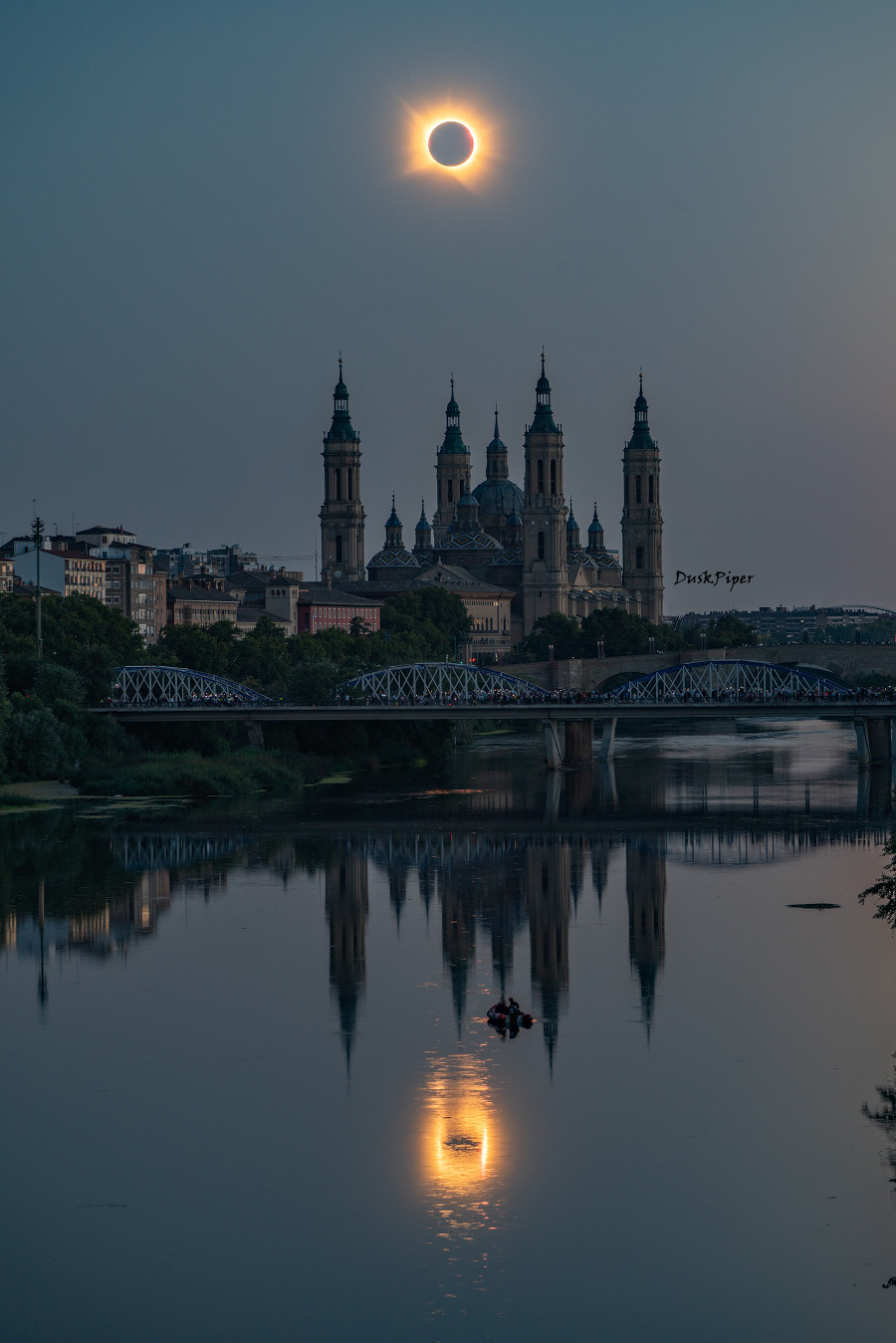
On August 12th, 2026, the Moon totally eclipsed the Sun and cast its shadow across Siberia, Greenland, Iceland, Spain, and Portugal. Today’s image features two total solar eclipses viewed from Zaragoza, Spain, one over the Cathedral-Basilica of Our Lady of the Pillar and the other reflecting in the Ebro River. For a few moments, Spain saw its first major total solar eclipse since 1905. Those witnessing totality may experience a chill in the air, the quieting of birds, the confused chirps of insects, and the shared awe of many. It’s the corona’s time to shine as the Sun’s bright disk is blocked by the Moon. Among other reasons to study eclipses, they help scientists understand why the corona is millions of degrees hotter than the Sun’s surface. Enthusiastic citizens can contribute to these studies by recording how wildlife responds, imaging the corona, and monitoring air temperature and clouds. More spectacular eclipse images: Solar Eclipse of 2026 August 12
Total Solar Eclipse from Greenland

Total Solar Eclipse from Greenland

2026-08-14

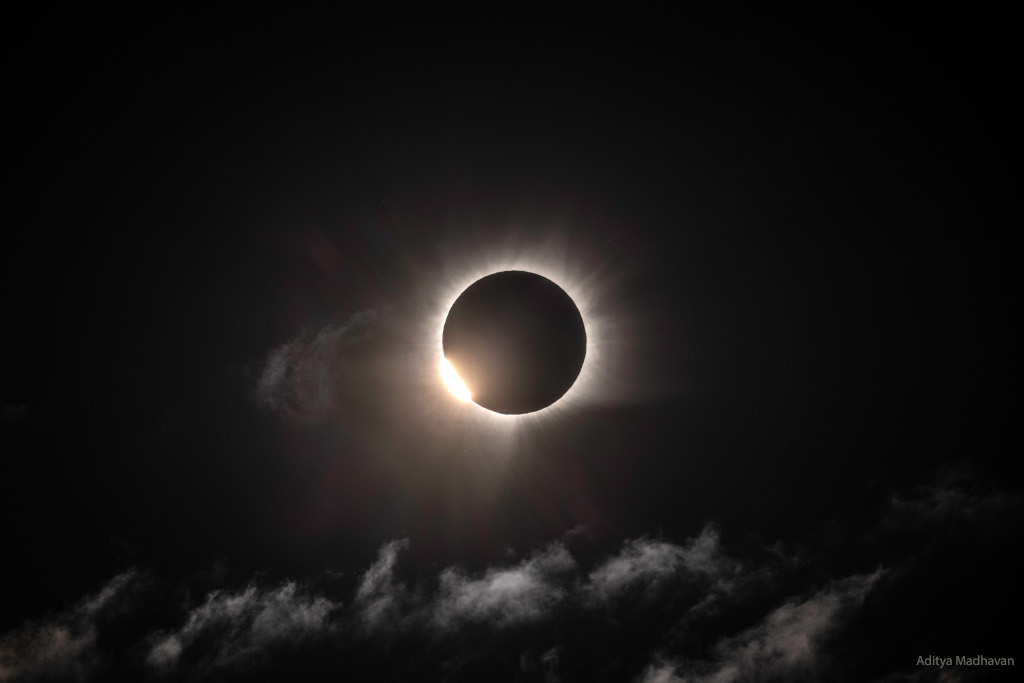
On August 12, the Moon's shadow reached out to touch our fair planet. Beginning in the Arctic Ocean, it swept along a narrow track that led the dark lunar umbra across parts of Greenland, Iceland, the Atlantic, Portugal, and northern Spain. And for a moment, denizens of Earth who found themselves with clear skies under the shadow of the Moon could witness a total solar eclipse. After dodging the weather by sea and making a landing along Rype Fjord on the Greenland east coast (at 71.07055N, 27.71252W), this hard-won snapshot was captured at 17:33:26 UTC. That's near the initial reach of clearing skies along the path of totality, so the image is likely one of the first unobstructed views of the totally eclipsed Sun. Through a break in the clouds, the stunning photo also records one of this eclipse's transient diamond rings and the magnificent solar corona emerging near the moment totality began. More spectacular eclipse images: Solar Eclipse of 2026 August 12
Bright Perseids from Sweden

Bright Perseids from Sweden

2026-08-15

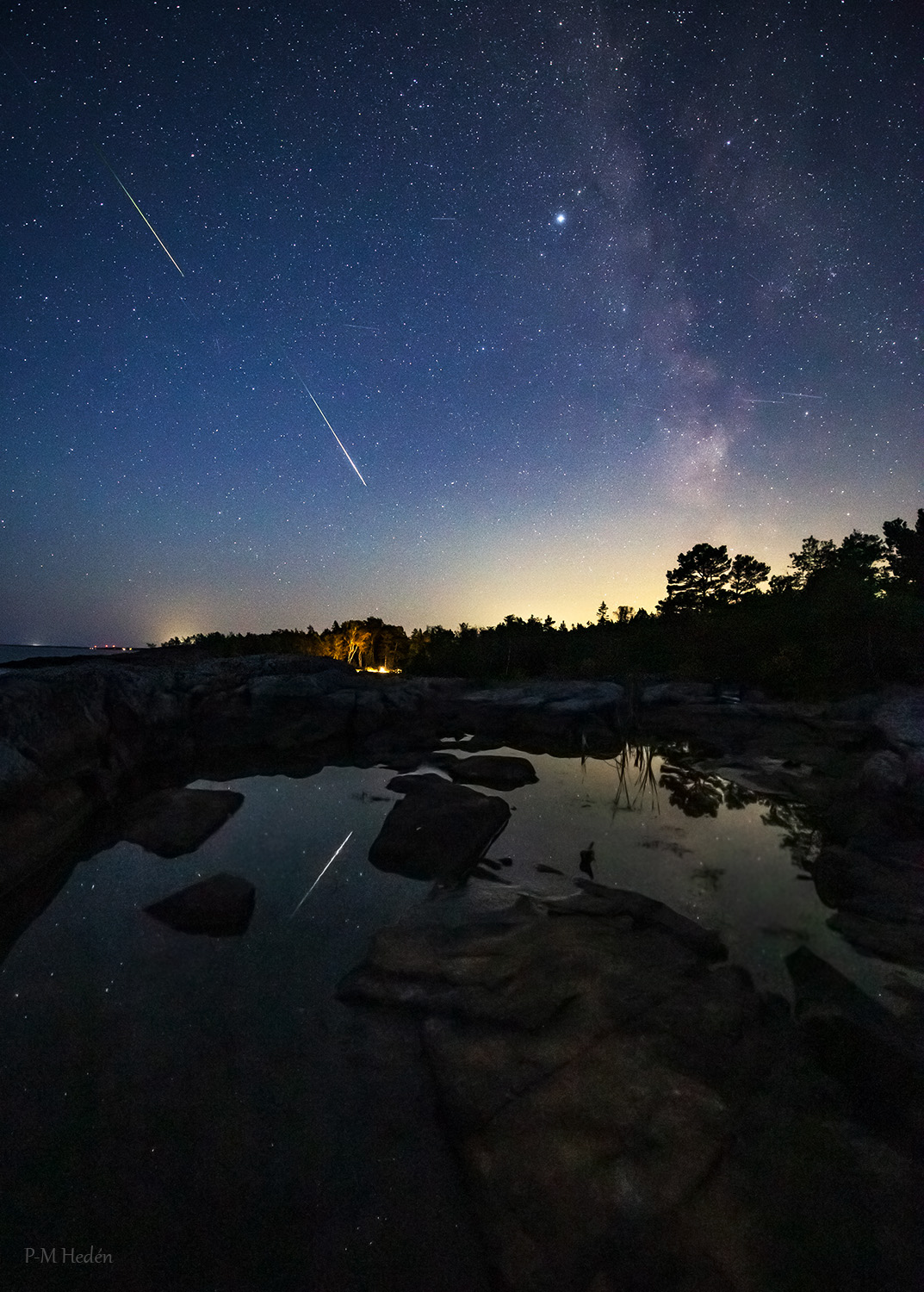
Known for its bright and fast meteors, the annual Perseid Meteor Shower comes to planet Earth's skies from a radiant in the heroic constellation Perseus. The popular northern summer celestial spectacle is created as grains of dust cast off along the orbit of periodic comet 109P/Swift-Tuttle vaporize in Earth's dense atmosphere, tracing brief, but beautiful streaks through the night. Taken near the shower's peak of activity on August 12, this composite image recorded two bright perseid meteors and one meteor's watery reflection from a location near the coastal village of Grisslehamn, Sweden. Almost as bright as Altair, brightest star on the scene, the meteors appear along with the faint, diffuse background of the Milky Way. This year, the shower's peak activity coincided with a New Moon, so perseid meteor flashes were undiminished by bright moonlight. And for many skywatchers, this night of bright perseid meteors followed their viewing of the silhouette of the New Moon in a much anticipated solar eclipse. Growing Gallery: Solar Eclipse of 2026 August 12
Milky Way over Yellowstone

Milky Way over Yellowstone

2026-08-16

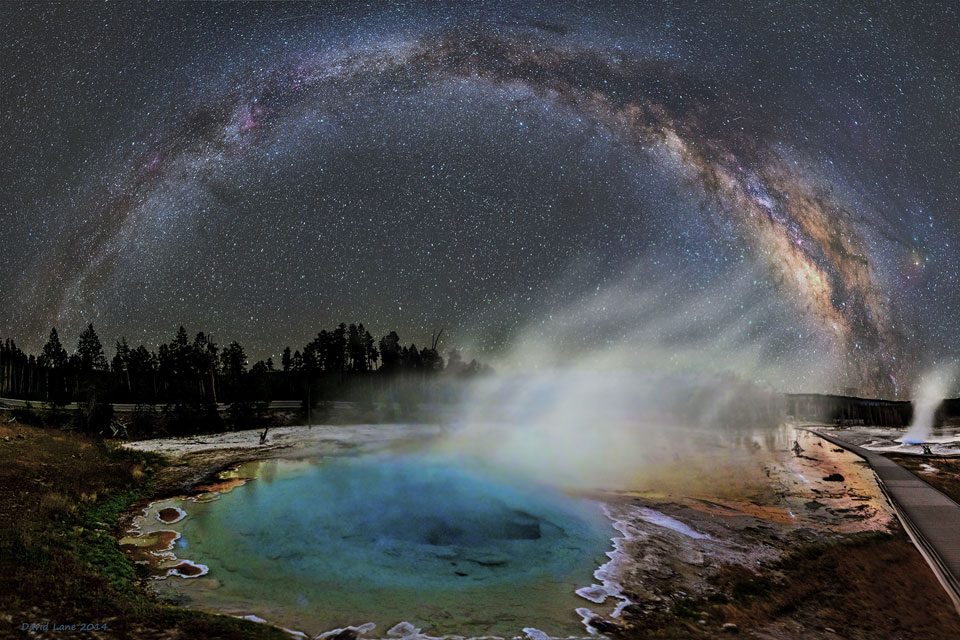
The Milky Way was not created by an evaporating lake. The colorful pool of water, about 10 meters across, is known as Silex Spring and is located in Yellowstone National Park in Wyoming, USA. Illuminated artificially, the colors are caused by layers of bacteria that grow in the hot spring. Steam rises off the spring, heated by underground magma associated with the Yellowstone Hotspot. Unrelated and far in the distance, the central band of our Milky Way Galaxy arches high overhead, a band lit by billions of stars. The picture features a 16-image panorama taken in 2014. If the Yellowstone Hotspot causes another supervolcanic eruption as it did about 640,000 years ago, a large part of North America would be affected.

A Golden Corona Eclipse

A Golden Corona Eclipse

2026-08-17

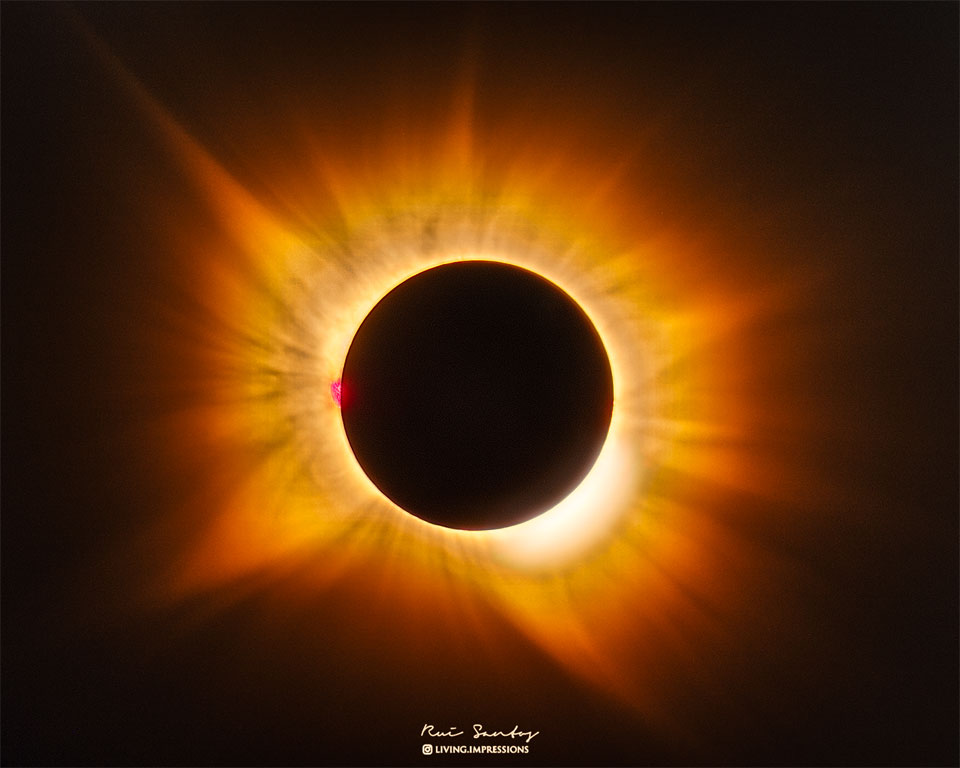
This total solar eclipse appeared not only poetically beautiful but scientifically interesting. Usually the solar corona appears white, and to some observers the corona of last week's total solar eclipse did appear this pearly color. But this time, totality observers in Spain saw a corona that appeared unusually golden. For one reason, from Spain, the totality occurred when the setting Sun was near the horizon. That low, sunlight travels through a large amount of air which scatters out blue light. An unusual amount of smoke in the air from nearby forest fires acted as a second filter, further scattering the remaining blue tones and deepening the already gold-dominated light. The HDR-processed, multiple-exposure featured image was captured from Benavente, Spain last week. One thing that did not appear golden was a hydrogen-glowing prominence that hovered over the Sun's left edge -- its original bright pink color survived. Gallery: Solar Eclipse of 2026 August 12
Perseids from Perseus

Perseids from Perseus

2026-08-18

This was a good year for the Perseids meteor shower. A key reason was the Moon was absent from lighting up Earth's night sky so that more meteors were visible than usual. Where was the Moon? It was busy visiting the Sun. Near the Perseids peak, the Moon moved directly in front of the Sun and created a total solar eclipse visible from Greenland and Spain. The Perseids occur when the Earth collides with a stream of Sun-orbiting debris cast off by Comet Swift-Tuttle. Perseid meteors, although typically only the size of a sand grain, tend to be fast and bright because Swift-Tuttle's debris orbits the Sun in a direction partly opposite Earth's orbital motion. In the featured image compilation, accumulated over several nights from Jizerka in the Czech Republic, the Perseids meteor streaks can be traced back to a single location on the sky -- its radiant in Perseus. Gallery: Perseids Meteor Shower of 2026

The Case of the Mysterious Maybe Meteor

The Case of the Mysterious Maybe Meteor

2026-08-19

Whatdunit? What disappeared while crossing a partially eclipsed Sun? Let’s present the evidence. The 24 frames-per-second video was taken in Spain (40°34'30.3"N 1°12'28.8"W) at 20:28 local time on August 12, 2026. The Perseids meteor shower was at its peak during this time. Is this a meteor? Meteor showers trace back to a region of the sky called a radiant point that corresponds to where the Earth is crossing a comet’s path. The object’s path might trace back to the Perseids’ radiant point in the Perseus constellation. The object trails a smaller angle on the sky than the 0.5 degree Sun and Moon, which is smaller than expected for a meteor. Its brightness does not extend much past the Sun, but a meteor burning up in the sky would not need sunlight to be seen. Perhaps the sunlight is reflecting off of the object? After cross-referencing the location, time, and point in the sky with a flight database, the culprit is found to be an airplane contrail!

Last 20 uploaded pictures, server can't handle all.